Why Does Las Vegas Sun Damage Skin So Fast, and What Actually Fixes It?

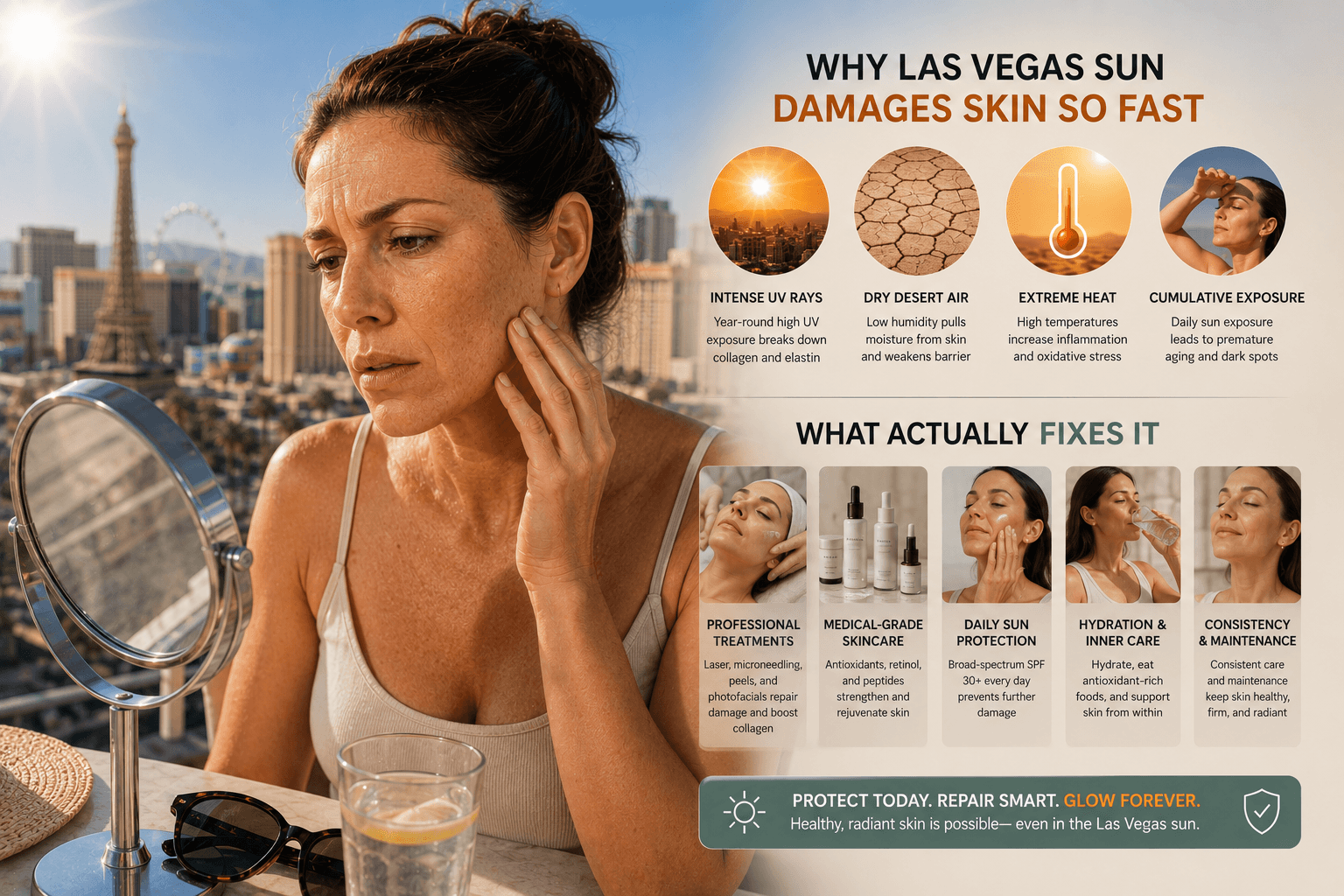
If you live in Las Vegas, you already know the sun here does not play around. Between the high desert elevation, the reflective surfaces on the Strip, and the sheer number of cloudless days we get every year, your skin is exposed to more UV radiation than most people experience anywhere else in the country. It shows up eventually: sun spots on the cheeks, a rougher texture along the jawline, a tone that looks a little uneven no matter how much concealer you use. Most people notice these changes long before they know what to call them, let alone what to do about them.
That is usually the moment someone starts searching for laser skin resurfacing, often after trying every serum and spot corrector on the shelf. This guide walks through why sun damage happens so aggressively in our climate, how to spot it early, what you can do to slow it down, and when a laser based treatment is genuinely worth considering.
Updated for August 2026, this article reflects the most current guidance we give patients at our Las Vegas practice.
Why Las Vegas Skin Ages Differently Than Skin Almost Anywhere Else
Nevada gets over 300 days of sunshine a year, and our elevation means there is less atmosphere to filter UV rays before they reach your skin. Add in low humidity, which pulls moisture out of the skin barrier, and you have a near perfect environment for accelerated photoaging. Dermatologists have long pointed to cumulative UV exposure as the single biggest driver of visible skin aging, often outweighing genetics by a wide margin.
For residents who spend time outdoors, whether that is golfing, hiking Red Rock, or just walking to the car in July, the damage tends to build quietly over years. Then one day the sun spots, the uneven tone, and the rougher texture all seem to show up at once.
What Does Sun Damaged Skin Actually Look Like?
Sun damage rarely announces itself as one single symptom. Instead, it tends to show up as a combination of smaller changes that add up over time.
Sun Spots and Age Spots
These are flat, brown or tan patches that typically appear on the areas that get the most sun exposure: cheeks, forehead, chest, and the backs of the hands. They are sometimes called liver spots, though they have nothing to do with the liver. They form when UV exposure triggers an overproduction of melanin in concentrated areas of skin.
Uneven Skin Tone and Pigmentation
Beyond distinct spots, many people notice a more general blotchiness or unevenness across the face. This kind of pigmentation can be harder to treat with topical products alone because it often sits deeper in the skin than surface discoloration.
Rough or Uneven Texture
Sun exposure breaks down collagen and disrupts the skin's natural renewal cycle, which can leave the surface feeling coarse or looking dull. This shows up as visible pores, a slightly bumpy feel, or skin that no longer reflects light evenly.
Fine Lines That Seem to Appear Overnight
UV damage accelerates the breakdown of collagen and elastin, the proteins responsible for keeping skin firm and smooth. Fine lines that seem to develop faster than expected are often a sign of cumulative sun exposure rather than age alone.
If any of this sounds familiar, you are not imagining it, and you are far from alone. These are some of the most common concerns we see at our practice, and they are exactly the kind of issues covered under sun damage and sun spots and age spots here in Las Vegas.
What Causes This Kind of Damage in the First Place?
It helps to understand the mechanism, because it changes how you think about prevention. UV radiation penetrates the skin and damages DNA within skin cells. Your body tries to repair this damage, but repeated exposure over years eventually overwhelms that repair process. The result is a buildup of pigmentation irregularities, collagen breakdown, and a weakened skin barrier.
Certain factors make this worse for Las Vegas residents specifically:
- Reflective surfaces. Concrete, glass buildings, and even the Strip's reflective architecture bounce UV rays back onto skin that might otherwise be shaded.
- Dry heat. Low humidity dehydrates the skin barrier, making it more vulnerable to UV related stress.
- Elevation. Las Vegas sits higher than many major cities, meaning less atmospheric filtering of UV rays.
- Driving exposure. Many people underestimate UVA exposure through car windows, which contributes to uneven tanning and pigmentation on the left side of the face and arms.
Can Sun Damage Be Prevented?
Prevention will always be more effective, and less expensive, than correction. A few habits make a meaningful difference over time.
Daily SPF, Even Indoors
Broad spectrum SPF 30 or higher applied every morning, rain or shine, is the single most protective habit for Las Vegas skin. UVA rays pass through windows, so this matters even on days spent mostly indoors or in the car.
Reapplication Throughout the Day
Sunscreen breaks down with heat and sweat. In our climate, reapplying every two hours during outdoor activity is not optional if you want it to actually work.
Protective Habits
Wide brimmed hats, UV blocking sunglasses, and seeking shade during peak UV hours (typically 10 a.m. to 4 p.m.) all reduce cumulative exposure.
Antioxidant Support
Topical antioxidants like vitamin C can help neutralize free radical damage caused by UV exposure, offering an extra layer of protection alongside sunscreen.
Even with excellent habits, most people who have lived in Las Vegas for any length of time already have some degree of visible sun damage. Prevention slows future damage, but it does not reverse what has already happened to the skin's surface.
When Does It Make Sense to Consider Laser Skin Resurfacing?
This is usually the point where people start looking into professional treatment. If you are dealing with visible sun spots, uneven tone, or a rougher texture that skincare products alone have not improved, it may be time to consider laser skin resurfacing rather than continuing to chase the problem with over the counter products.
Laser treatments work differently than topical products because they target pigment and stimulate collagen renewal at a level creams cannot reach. Instead of just masking discoloration, the goal is to actually break up excess pigment and encourage the skin to produce healthier, more even toned tissue over time.
How PicoSure Pro Addresses Sun Damage, Pigmentation, and Texture
At our practice, PicoSure Pro is the laser platform we use for this kind of concern. It uses ultra short pulses of energy to target pigment in the skin, breaking it into smaller particles that the body naturally clears over the following weeks. Because the technology works so quickly, it does this with less heat and less disruption to the surrounding skin compared to older laser technologies.
Patients typically choose PicoSure Pro for concerns like:
- Sun spots and age spots
- Uneven pigmentation and blotchy tone
- Dull or rough texture
- General signs of sun related aging
Most people see gradual improvement over a series of sessions rather than one dramatic change, which allows the skin to heal naturally between treatments. This is one of the reasons laser skin resurfacing with PicoSure Pro has become a popular option for Las Vegas residents who want visible results without significant downtime.
What About Texture Specifically?
For patients whose primary concern is texture irregularities or uneven skin texture rather than pigmentation alone, we sometimes recommend pairing PicoSure Pro with Potenza RF Microneedling. Potenza uses radiofrequency energy combined with microneedling to stimulate collagen production, which can further improve texture and firmness alongside the tone correcting benefits of laser treatment. Whether this combination makes sense depends on your specific skin and goals, which is something we assess during a consultation.
You can browse real patient results in our before and after gallery to get a sense of what these treatments look like in practice.
Who Is a Good Candidate for This Kind of Treatment?
Generally, good candidates are people who:
- Have visible sun spots, pigmentation, or uneven tone that has not responded to topical products
- Notice rough or dull texture that makes skin look older than they feel
- Want a professional, medically supervised approach rather than DIY treatments
- Are looking for gradual, natural looking improvement rather than a single dramatic transformation
Skin type, tone, and the depth of pigmentation all factor into what settings and treatment plan make sense, which is why an in person evaluation matters more than trying to self diagnose based on a search result.
Frequently Asked Questions
Is laser skin resurfacing effective for sun spots and age spots? Yes. Laser treatments like PicoSure Pro target the excess pigment responsible for sun spots and age spots, breaking it down so the body can clear it naturally over several weeks.
How many sessions of laser skin resurfacing are usually needed? Most patients need a series of sessions, though the exact number depends on how much pigmentation and texture irregularity is present. Your provider will outline a personalized plan during your consultation.
Does laser skin resurfacing hurt or require downtime? Most patients describe the sensation as mild warmth or light tingling. Downtime is typically minimal, though some redness can occur for a short period afterward.
What is the difference between laser skin resurfacing and microneedling for texture concerns? Laser treatment primarily targets pigment and tone, while RF microneedling focuses more on stimulating collagen for firmness and texture. Many patients benefit from combining both approaches.
Can laser skin resurfacing prevent future sun damage? No treatment prevents future sun damage on its own. Daily SPF and sun protective habits remain essential, even after treatment, to protect your results long term.
Is laser skin resurfacing safe for Las Vegas's climate and sun exposure? Yes, when performed by an experienced provider and followed by proper sun protection. Because Las Vegas has such intense year round UV exposure, aftercare and daily sunscreen are especially important to maintain results.
The Verdict: Your Skin Has Been Through a Lot, Give It Something Back
Las Vegas asks a lot of your skin, between the sun, the dry air, and the desert elevation that never quite lets up. If sun spots, uneven tone, or rough texture have started to bother you more than they used to, that is not vanity, that is your skin asking for a little backup.
The good news is you do not have to accept sun damage as a permanent souvenir of desert living. A thoughtful combination of daily protection and the right professional treatment can make a real, visible difference.
If you are ready to talk through your options, the team at No. 1 Medspa in Las Vegas is happy to walk you through what PicoSure Pro and other skin health treatments could look like for your skin specifically. You can reach out here to schedule a consultation and get a personalized plan built around your goals.